
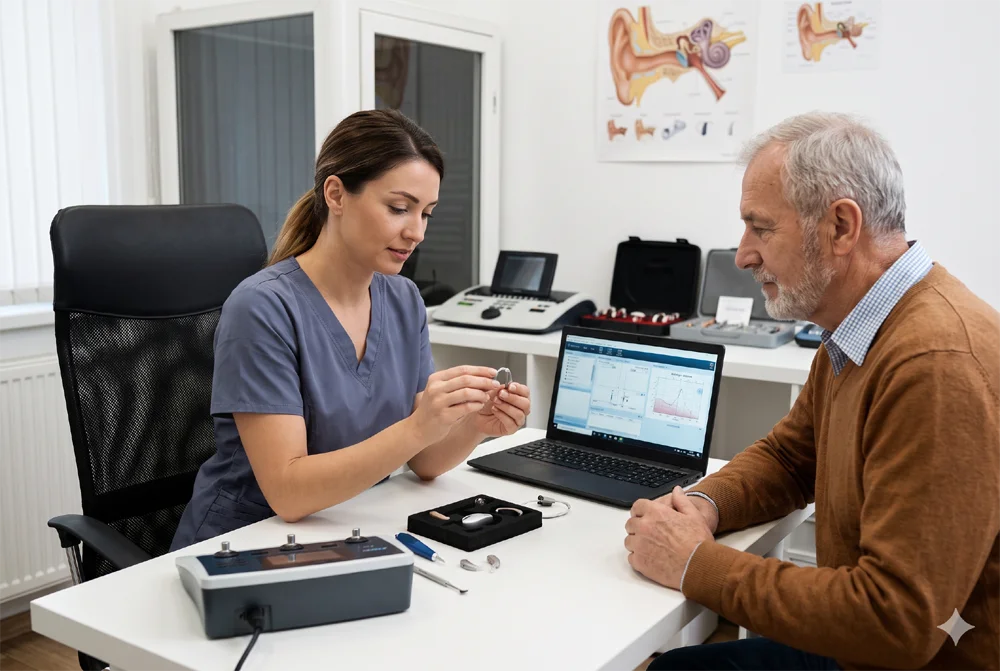
Advanced Audiology Including Hearing Aid Services in Faridabad
Hearing plays an important role in communication, learning, social interaction, and everyday activities. Difficulty hearing conversations, frequently asking others to repeat themselves, or increasing the television volume may indicate a hearing problem. Hearing difficulties can affect people of all ages and may develop gradually or occur suddenly.
Advanced Audiology Including Hearing Aid Services in Faridabad focuses on assessing hearing ability and identifying suitable options for people experiencing hearing difficulties. Audiology services may include hearing assessments, interpretation of test results, hearing aid counselling, device selection, fitting, and follow-up support. The appropriate approach depends on the person's hearing profile, communication needs, lifestyle, and any underlying medical condition.
A comprehensive assessment can help determine whether hearing aids, medical treatment, further investigations, or other hearing rehabilitation options may be appropriate.
Audiology is the healthcare discipline concerned with hearing and related balance functions. Audiologists use specialised tests to assess hearing sensitivity, identify the type and degree of hearing loss, and support appropriate hearing rehabilitation.
Hearing loss may affect one ear or both ears. It can be temporary or permanent, depending on the cause. Some conditions, such as earwax blockage or middle-ear fluid, may be medically treatable, while other forms of hearing loss may benefit from hearing aids or additional rehabilitation.
Audiological evaluation is important because hearing difficulties cannot always be identified accurately from symptoms alone. Test results help guide the next steps in assessment and care.
Hearing loss may develop gradually, making it difficult for a person to recognise the changes initially. Common signs include:
These symptoms may have different causes. A hearing assessment can help determine whether hearing loss is present and whether further medical evaluation is required.
Understanding the type of hearing loss helps guide appropriate treatment and device recommendations.
Conductive hearing loss occurs when sound does not travel efficiently through the outer or middle ear. Possible causes include earwax blockage, middle-ear fluid, eardrum problems, or certain abnormalities of the middle-ear bones.
Some conductive problems can be treated medically or surgically. A hearing aid may be considered in selected cases when appropriate, depending on the underlying condition.
Sensorineural hearing loss occurs when the inner ear or the auditory nerve pathways are affected. Causes may include ageing, noise exposure, genetic factors, certain medications, infections, or other medical conditions.
Depending on the type and degree of hearing loss, hearing aids or other hearing rehabilitation options may be recommended.
Mixed hearing loss involves both conductive and sensorineural components. Management depends on the underlying causes and the results of the hearing assessment.
Hearing tests provide information about how well a person hears different sounds and understands speech. The clinician selects tests according to the person's age, symptoms, medical history, and communication needs.
Pure Tone Audiometry (PTA) is a commonly used hearing test that measures the softest sounds a person can hear at different frequencies. Testing is generally performed using headphones or earphones in a suitable testing environment.
The results are recorded on an audiogram, which helps show the degree and pattern of hearing loss. When appropriate, air-conduction and bone-conduction testing can help distinguish conductive from sensorineural hearing loss.
Speech testing assesses how well a person can hear and recognise spoken words. It may help evaluate communication difficulties and provide information relevant to hearing aid planning.
Tympanometry assesses how the eardrum and middle-ear system respond to changes in air pressure. It can provide information about middle-ear function and may help identify issues such as fluid behind the eardrum or pressure-related abnormalities.
Otoacoustic emissions testing measures sounds produced by the inner ear in response to acoustic stimulation. It is used in selected assessments, including some newborn and paediatric hearing screening programmes.
Other tests may be recommended depending on the clinical situation. These can include auditory brainstem response testing, specialised paediatric assessments, or further investigations when results suggest a need for additional evaluation.
Not every patient requires every test. The assessment should be tailored to the symptoms and clinical findings.
Hearing aids are electronic devices designed to make sounds more audible for people with hearing loss. Modern devices may use digital signal processing to adjust sound according to the user's hearing profile and listening environment.
Hearing aids do not restore normal hearing, but appropriately selected and fitted devices can improve access to speech and other sounds for many people.
The most appropriate device depends on hearing test results, ear anatomy, dexterity, communication requirements, personal preferences, and budget.
Behind-the-ear (BTE) hearing aids: These devices sit behind the ear and direct sound into the ear through an appropriate coupling. They are available for a range of hearing loss levels.
Receiver-in-canal (RIC) hearing aids: These devices place the receiver in or near the ear canal and may offer a compact design with different fitting options.
In-the-ear (ITE) hearing aids: These devices are custom-made to fit within part of the outer ear. Suitability depends on the person's hearing needs and ear anatomy.
In-the-canal (ITC) and completely-in-canal (CIC) devices: These are smaller custom-style options that fit partly or more deeply within the ear canal. They may not be suitable for every type or degree of hearing loss.
The selection process should focus on clinical suitability and individual needs rather than appearance or features alone.
Selecting a hearing aid involves more than choosing a device. Proper assessment, fitting, adjustment, and follow-up are important parts of hearing rehabilitation.
Counselling helps explain the person's hearing test results, available device options, expected benefits, limitations, maintenance requirements, and likely costs. It also provides an opportunity to discuss communication difficulties and listening priorities.
During fitting, the device is programmed or adjusted according to the individual's hearing profile and the manufacturer's fitting approach. When indicated, verification measures can help assess whether the hearing aid is providing suitable amplification.
The clinician may also explain how to insert and remove the device, charge or replace batteries, clean the equipment, and manage common issues.
Some patients need time to adapt to amplified sounds. Everyday environments may initially seem unusually loud, and further adjustments may be required. A hearing aid trial, where available and appropriate, can help assess comfort and practical benefit.
Follow-up appointments help review comfort, device use, listening outcomes, and any problems with sound quality. Adjustments, maintenance, and additional counselling may improve the overall experience.
Regular hearing reviews are also important because hearing ability and communication needs can change over time.
Hearing support should be tailored to the age and needs of the individual.
For children, early identification of hearing loss is important because hearing supports speech, language, learning, and social development. Paediatric hearing assessment and device fitting require age-appropriate testing and ongoing monitoring.
Older adults may experience age-related hearing loss that affects conversations, family interactions, and participation in social activities. A hearing assessment can help identify suitable rehabilitation options and determine whether further medical evaluation is necessary.
People of any age with sudden hearing changes should seek urgent medical assessment rather than relying on a hearing aid appointment alone.
Consider a professional hearing assessment if you notice persistent difficulty understanding speech, frequently increase sound volume, or experience hearing changes that affect daily communication.
Sudden hearing loss, particularly in one ear, requires urgent medical evaluation. Hearing changes accompanied by severe dizziness, facial weakness, or other neurological symptoms also need urgent attention.
For people seeking Advanced Audiology Including Hearing Aid Services in Faridabad, an appropriate assessment can help establish the type of hearing difficulty and guide decisions about treatment, hearing aids, or further investigation. Patients should confirm the availability of specific tests, devices, and fitting services directly with the healthcare provider.
Depending on the person's needs, an audiology assessment may include a hearing history, ear examination, Pure Tone Audiometry, speech testing, tympanometry, or other specialised tests. The exact combination depends on the clinical situation.
A hearing assessment can identify the type and degree of hearing loss. If hearing aids are likely to help, the clinician can discuss suitable devices based on test results, communication needs, lifestyle, and personal preferences.
No. Hearing aids amplify and process sounds to improve access to speech and other sounds, but they do not restore normal hearing. The amount of benefit varies between individuals.
Adjustment varies from person to person. Some users adapt relatively quickly, while others need several weeks of regular use and follow-up adjustments. Individual guidance can help make the transition easier.
Yes. Hearing aids may be recommended for children with certain types of hearing loss. Appropriate paediatric testing, device fitting, monitoring, and follow-up are important for supporting communication and development.
Sudden hearing loss, especially in one ear, should be assessed urgently. Do not delay medical evaluation by waiting for a routine hearing aid consultation.



Write a Reply or Comment